August 24, 2026
Situational Awareness: The $45 Billion Blowup
Leopold Aschenbrenner raised $225 million, compounded it past $20 billion, and lost most of it in twenty-nine days. Every filing the fund ever made, charted, and the mechanics of how a 25% drawdown became a total loss.

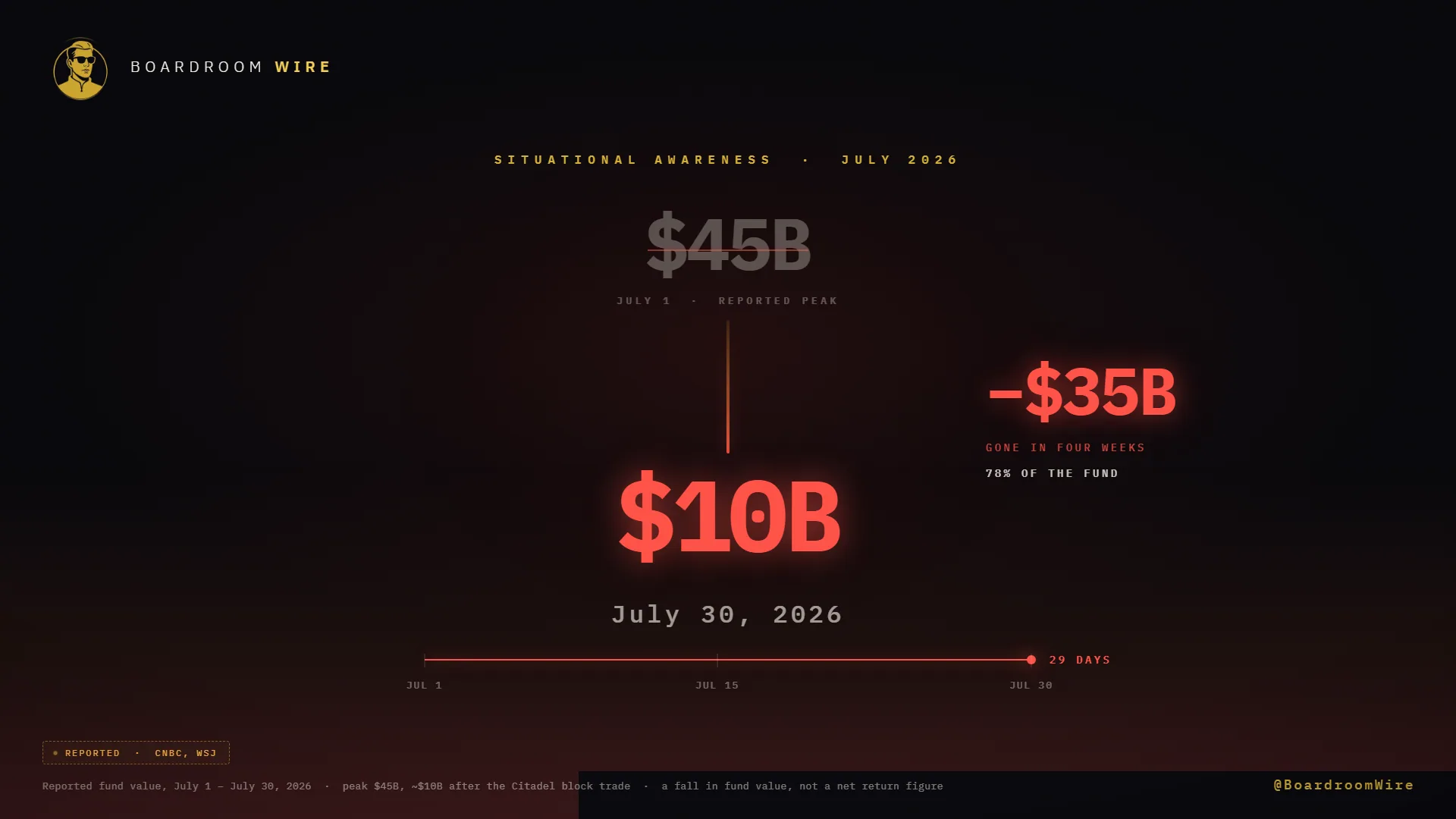
On July 30th, 25 year old Leopold Aschenbrenner’s $45 billion fund, Situational Awareness, exploded. He lost nearly everything, and was forced to sell his entire public stock portfolio to Ken Griffin’s Citadel. All just days before his wedding, to boot.
 Tap to enlarge
 SourceReported fund value, July 1 – July 30, 2026 (CNBC, WSJ). A fall in fund value, not a net return figure.
But how did Situational Awareness go from 439% returns in six months to liquidated in under four weeks? And how did a 25 year old with no trading experience get $45 billion to lose in the first place?
Who he is
Well Leopold is not a normal 25 year old, he’s a child prodigy who is as supertracked as it gets.
Born in Germany to two physician parents, Leopold showed extreme intelligence from a very young age. He won Germany’s national science competition, graduated high school early, and was admitted into Columbia University at just 15 years old. During his time at Columbia he double majored in mathematics and economics, founded the effective altruism chapter, and graduated as the class valedictorian in 2021 at just 19 years old.
So by any standard, he was clearly a genius and going to be successful at whatever he chose to pursue. And ironically, he’d go on to start his career working for another effective altruist, Sam Bankman Fried, at FTX Future Fund.
The Future Fund was essentially a charitable fund for causes that SBF cared about: AI safety, biosecurity, effective altruism stuff essentially. This is also where Aschenbrenner met his wife, Avital Balwit, who is currently Chief of Staff to Anthropic CEO Dario Amodei.
Leopold only did a short 10 month stint there, from February 2022 until November 2022, and resigned days before FTX’s legendary bankruptcy.
Naturally, Leopold landed on his feet, and in 2023 joined OpenAI, where he’d get caught in further controversy.
The firing and the manifesto
The firing
Leopold joined OpenAI’s Superalignment team, led by OpenAI cofounder Ilya Sutskever. The team was generally focused on ensuring alignment between superintelligence and people writ large.
Shortly after joining, OpenAI suffered a hacking incident and a breach of some of their internal systems, which caused Leopold to pen a memo directly to the board of OpenAI. In this memo, Leopold stated that the company’s security was “egregiously insufficient to protect against the theft of model weights or key algorithmic secrets from foreign actors,” citing China as a principal threat.
Needless to say, a 20-something year old employee who’d been at the company just a few months penning such a critical memo to the board of directors did not sit well with much of the leadership team. In April 2024, OpenAI fired Leopold, citing that he improperly leaked confidential information to external researchers.
Leopold provided his own perspective on the Dwarkesh Patel podcast, stating that the leak was nothing more than a benign brainstorming document he shared with three external researchers for feedback, and that he was told directly that his memo was a major reason for his dismissal.
The manifesto
In June 2024, just two months after his exit from OpenAI, Leopold subsequently launched his hedge fund and manifesto, titled “Situational Awareness.”
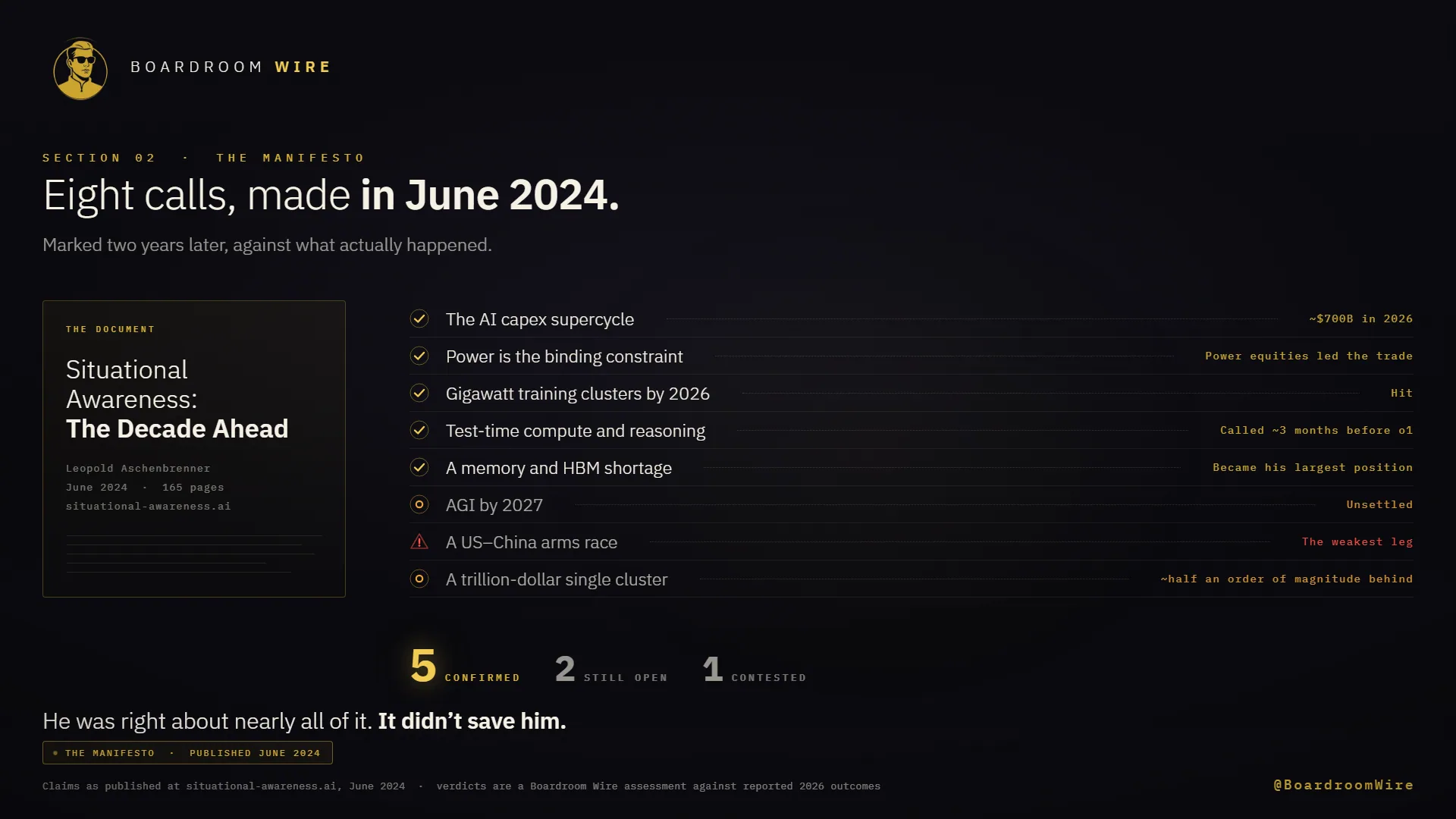
In this manifesto, Leopold argues that no more than a few hundred people truly understand AI and the economic and societal implications that are to come in the coming decade. Aschenbrenner goes on to correctly predict several key themes and bottlenecks that have come to fruition: the AI capex supercycle, the power and energy bottleneck, and full gigawatt datacenter clusters by 2026.
 Tap to enlarge
 SourceClaims as published at situational-awareness.ai, June 2024. Verdicts are a Boardroom Wire assessment.
Leopold’s entire investing strategy with the fund was based on the contents of this manifesto. And while his writing was ultimately controversial, he attracted seed capital from some of the premier investors across the industry.
The fund launch and the rise
Fund launch and rise
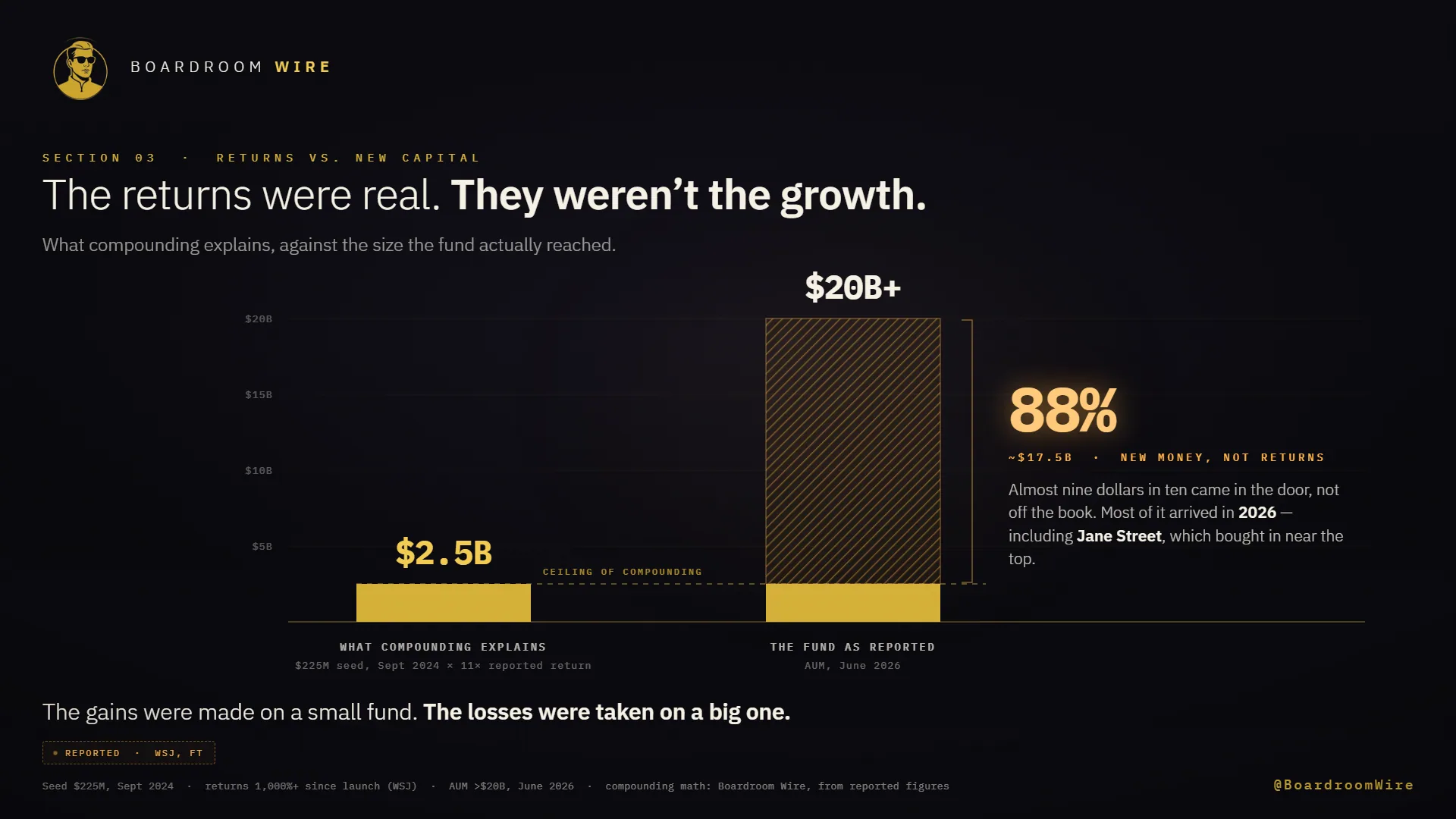
Backers included Stripe co-founders Patrick and John Collison, former GitHub CEO Nat Friedman, investor Daniel Gross, and, unusually, even Jane Street later joined as an institutional investor. Reports state that the fund started at around $225 million AUM in September 2024. And Situational Awareness would then go on a run that was absolutely legendary.
The portfolio deep dive
In under two years, Situational Awareness compounded over 1,000% after fees. And thanks to SEC filings, we can watch exactly how he did it.
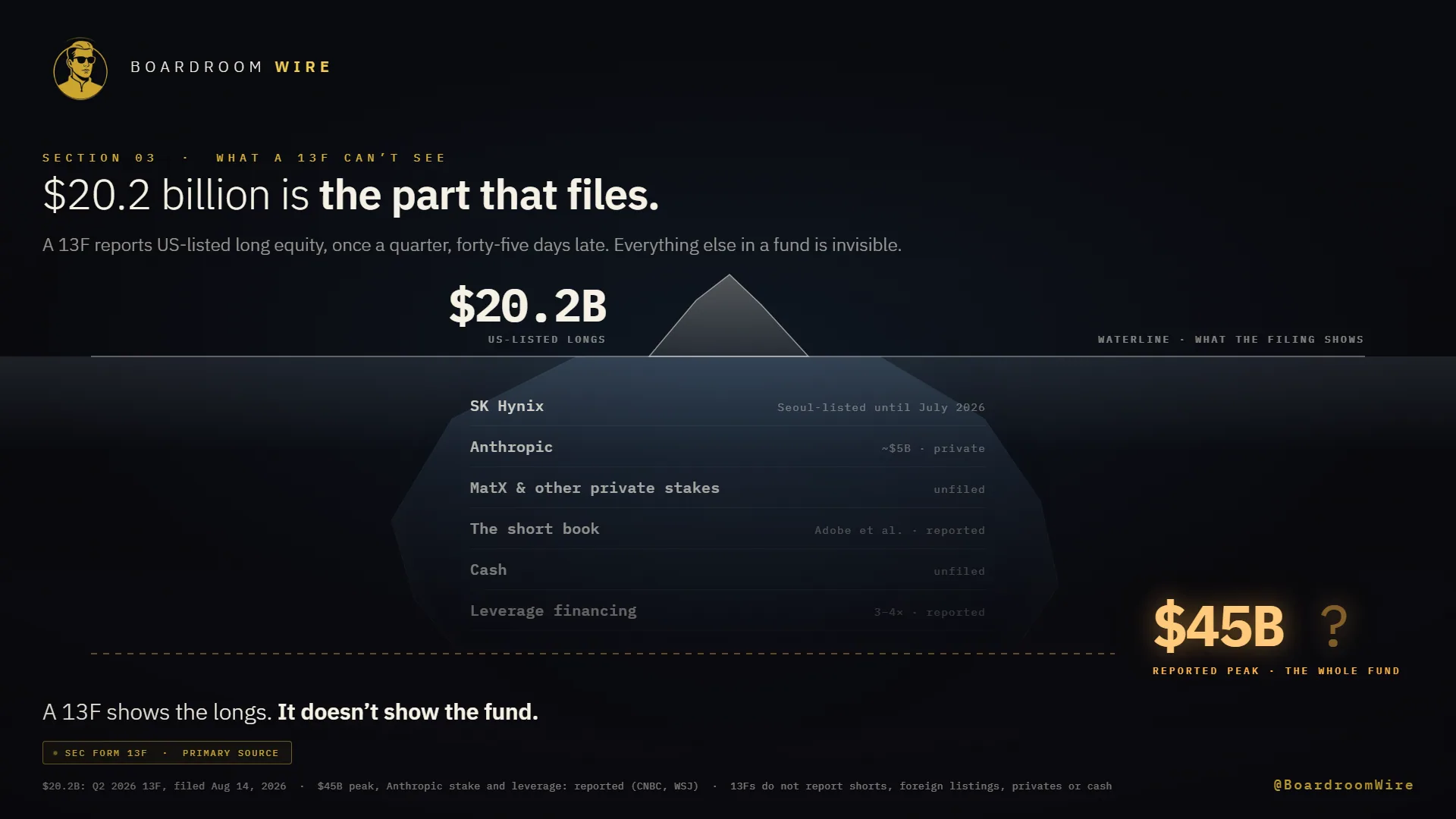
Now, we don’t have full blown returns data and trade activity, but we can use his 13F filings to piece together the composition of his portfolio. Worth noting these only capture US-listed long positions, so foreign stocks like SK Hynix, private stakes like Anthropic, and any short positions don’t show up.
 Tap to enlarge
 SourceQ2 2026 13F, filed Aug 14, 2026. The $45B peak, Anthropic stake and leverage are reported (CNBC, WSJ).
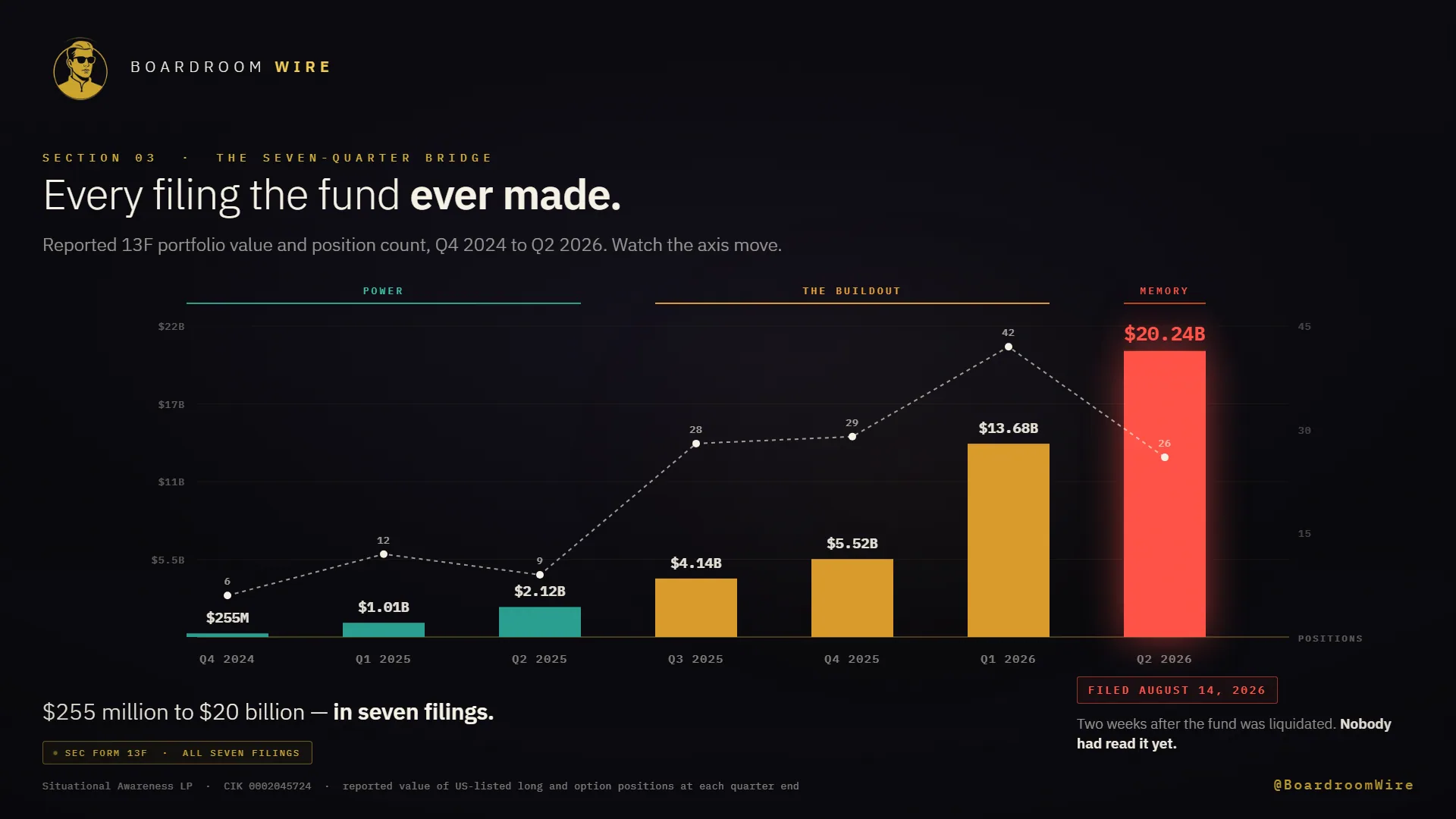
The first filing, for the quarter ending December 2024, shows a fund with $255 million and just six core positions.
Vistra. Talen Energy. Constellation Energy. Vertiv. Modine Manufacturing. And Marvell, which was the only semiconductor stock in the entire book. His portfolio was heavily focused on the power and energy bottlenecks that were critical to getting data centers up and running, and to the downstream AI supply chain.
Through 2025, he moved up the stack.
He shifted his focus to AI data center plays and bitcoin miners, a genius move, because these companies were already sitting on enormous amounts of contracted power they could shift into AI. Leopold bought into them early. Companies like Core Scientific, IREN, Applied Digital, Riot, and CoreWeave.
Over this period he also started demonstrating a less concentrated approach, going from six positions to twenty eight. And the portfolio grew to $4 billion, from its original $255 million.
So 2025 built on his original energy thesis from 2024, but he took it up a layer in the AI value chain.
 Tap to enlarge
 SourceSEC Form 13F · Situational Awareness LP · CIK 0002045724 · all seven filings, Q4 2024 – Q2 2026.
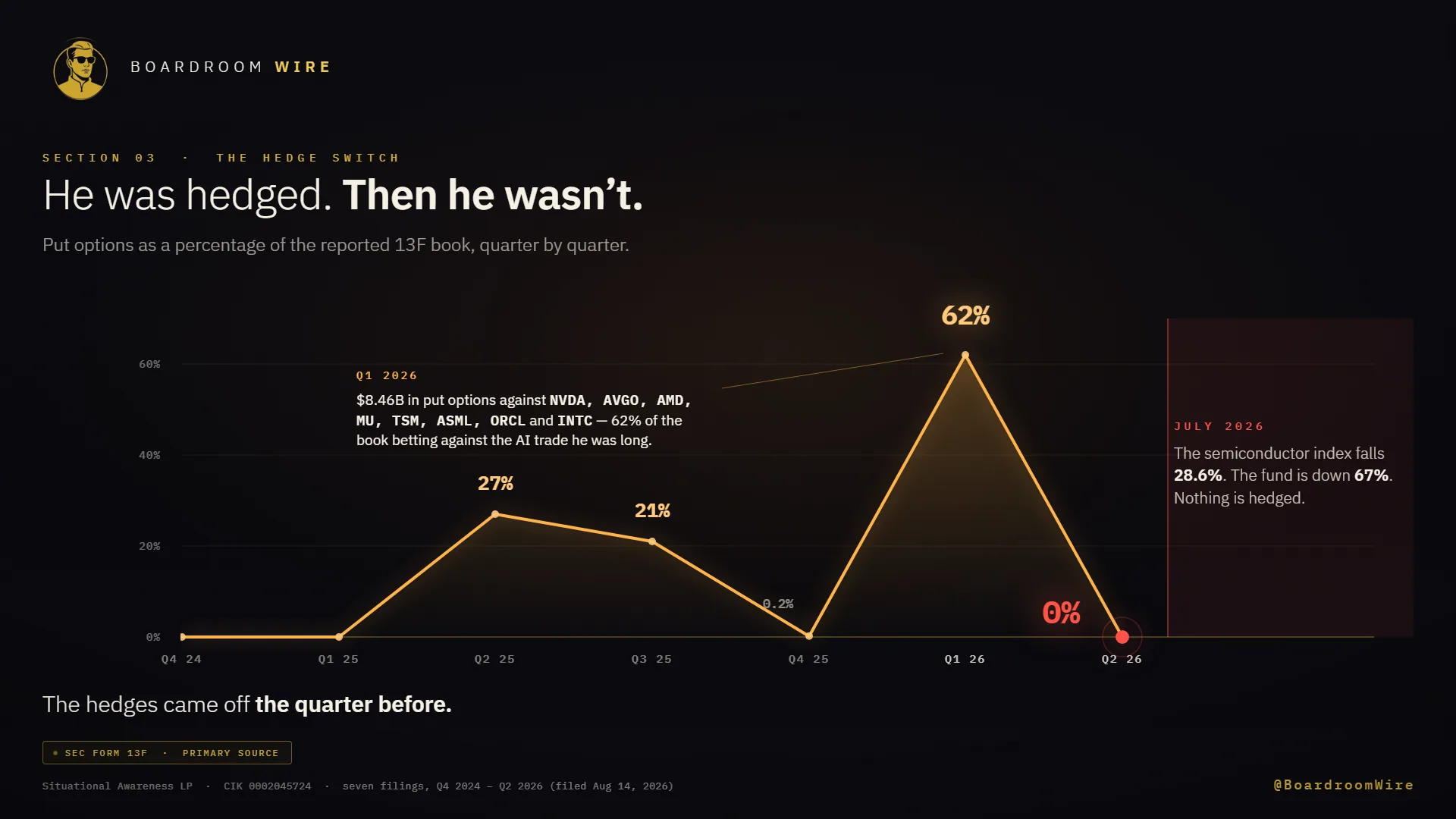
But the first quarter of 2026 reporting is where things get really interesting.
The portfolio more than doubled again, but over 60% of the book was put options against core semiconductor names. Nvidia, Oracle, Broadcom, AMD, Micron, TSMC, ASML and Intel. Over $8 billion in notional bets against exactly the companies you’d expect an AI fund to be long.
 Tap to enlarge
 SourceSEC Form 13F · CIK 0002045724 · seven filings, Q4 2024 – Q2 2026 (filed Aug 14, 2026).
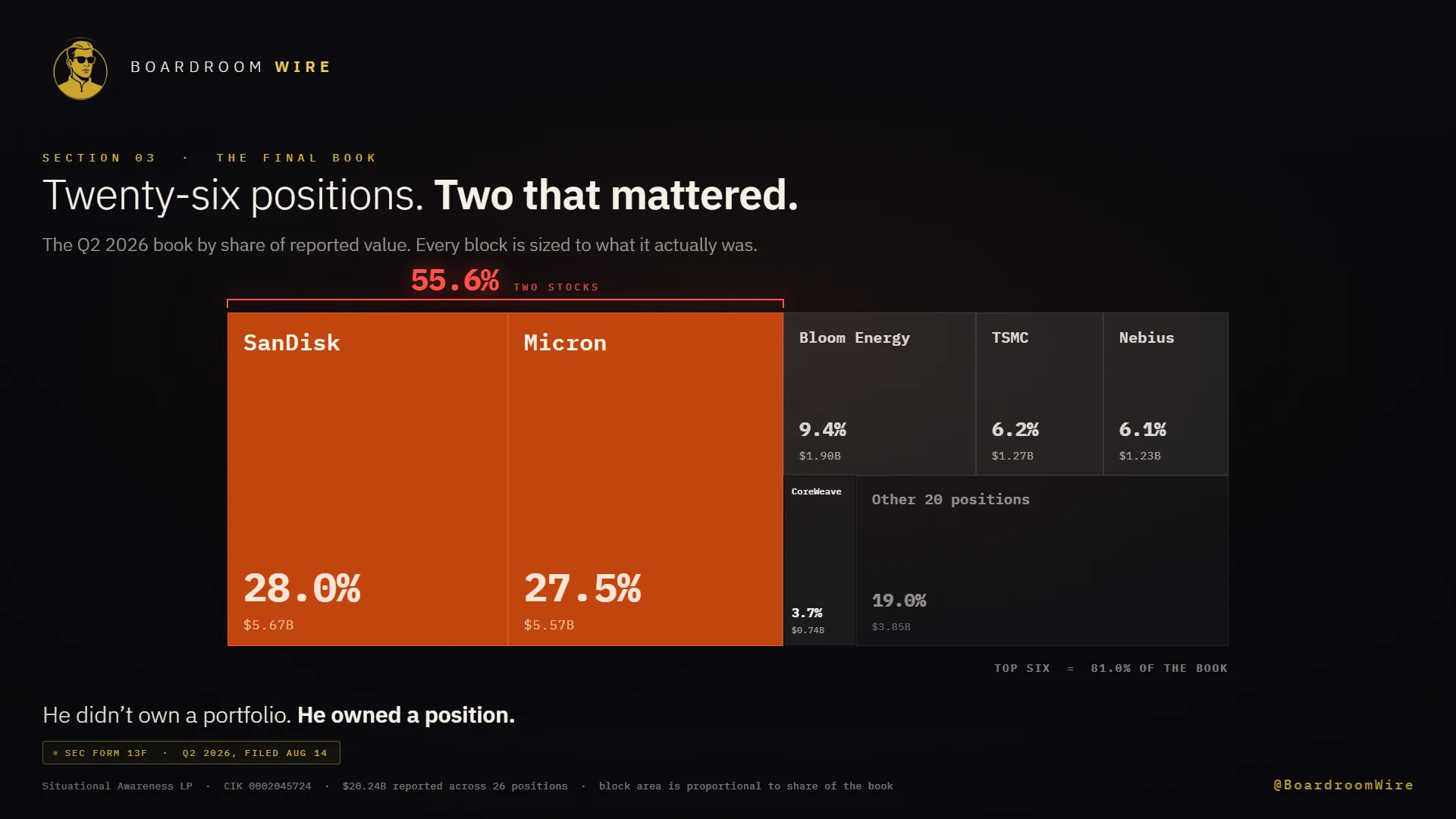
But this was likely Leopold hedging some of his higher risk bets. Because in his June 30th, 2026 filing, which actually came out after the epic meltdown, he had gotten rid of all of those positions and gone long memory. 55% of his $20 billion reported portfolio was in SanDisk and Micron alone, and over 80% of it sat in just six stocks.
 Tap to enlarge
 SourceSEC Form 13F, Q2 2026, filed Aug 14, 2026 · $20.24B across 26 positions.
Needless to say, that isn’t exactly best practice from a risk management perspective. But in fairness, he had been on an absolute tear.
Over this entire arc, from power, to the AI buildout, then memory, he got every single call right. The Wall Street Journal reported his returns were well over 1,000% since launch, with the Financial Times reporting over 439% in the first half of 2026 alone.
 Tap to enlarge
 SourceSeed $225M, Sept 2024 · returns 1,000%+ since launch (WSJ) · AUM >$20B, June 2026 · compounding math: Boardroom Wire, from reported figures.
And again, this is only the US-listed portion. At its peak, his fund reached a reported $45 billion.
But Leopold’s conviction and concentration would ultimately be his downfall.
July
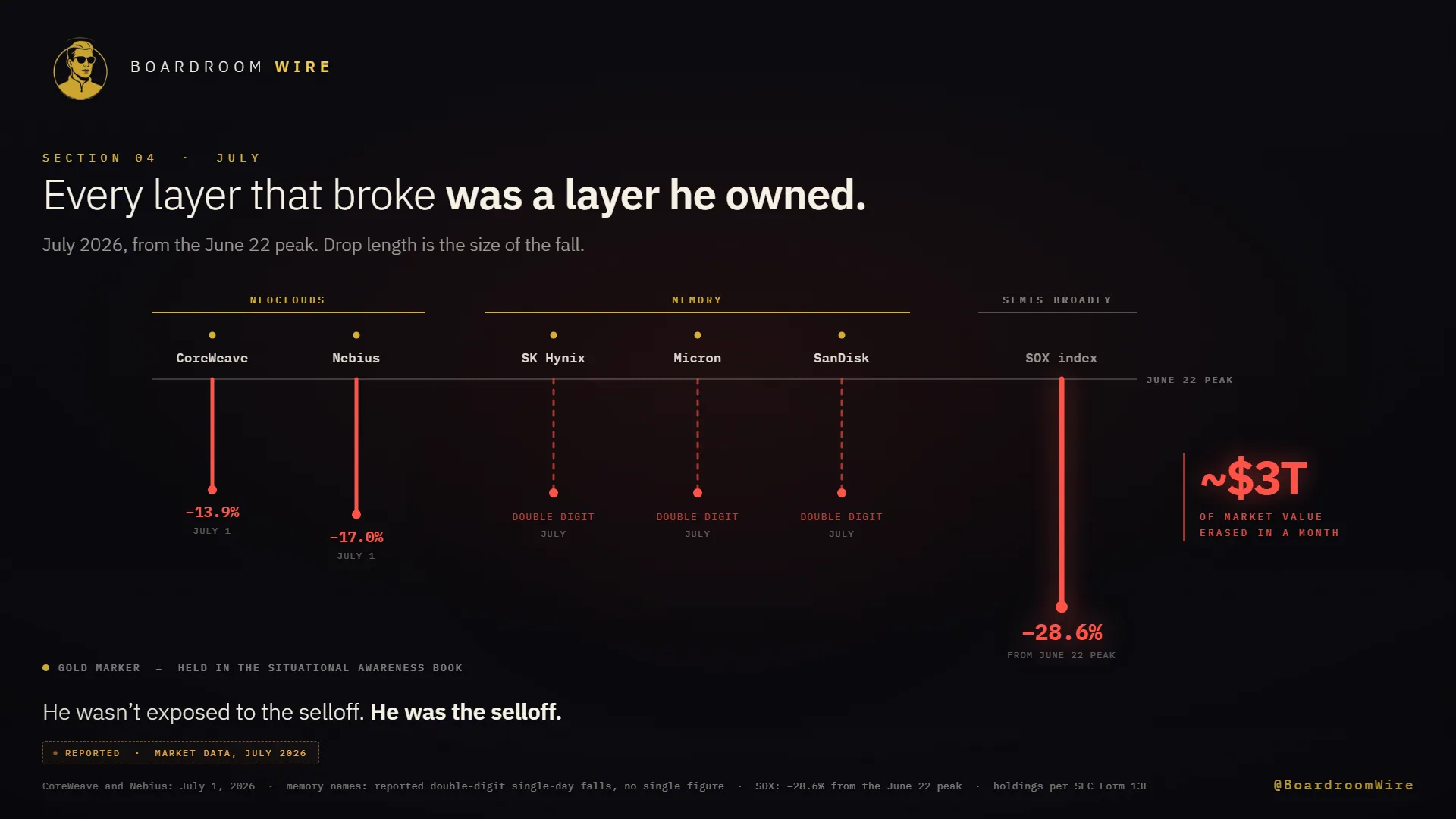
In July, the bottom fell out of the entire AI trade.
 Tap to enlarge
 SourceCoreWeave and Nebius: July 1, 2026 · memory names: reported double-digit single-day falls · SOX: −28.6% from the June 22 peak.
It started when Meta announced they were launching a cloud business and would begin renting out their AI compute to the broader market. This pushed big neocloud names like CoreWeave and Nebius down 15%, both of which were major positions for Situational Awareness. Memory stocks also got battered, with SK Hynix, Micron and SanDisk all seeing double digit drops in a single day.
Underneath everything, the semiconductor index dropped almost 29% from its June peak, erasing roughly $3 trillion in market value.
And every sector that broke (the neoclouds, the memory names, the power complex) was a layer Leopold owned.
The mechanics
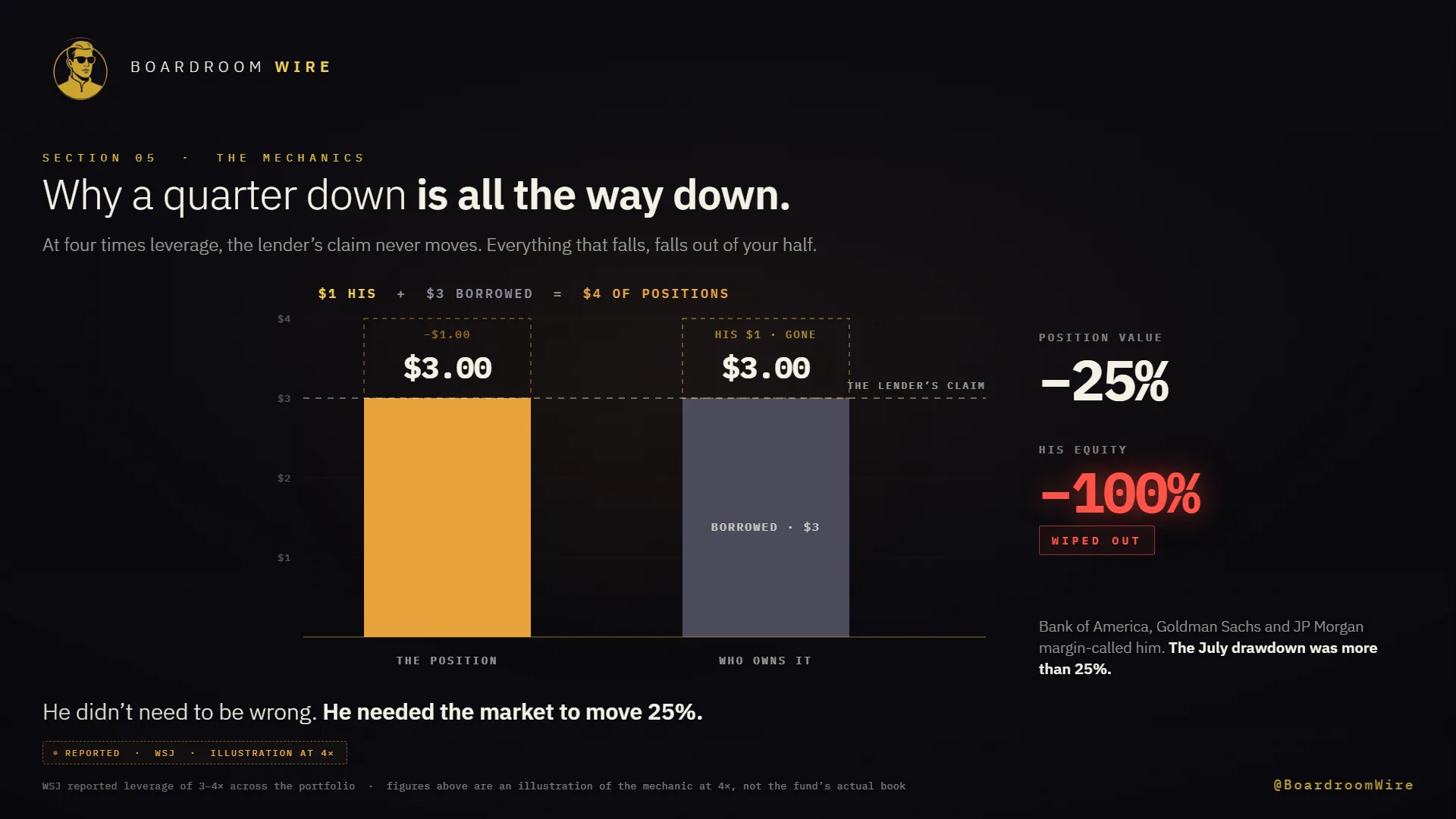
So Situational Awareness had a terrible month. But why did a 30% drawdown wipe out his fund?
The answer is leverage.
 Tap to enlarge
 SourceWSJ reported leverage of 3–4× across the portfolio. Figures shown are an illustration of the mechanic at 4×, not the fund’s actual book.
The Wall Street Journal reported that Leopold was running 3 to 4x leverage across the portfolio, borrowing 3 to 4 dollars for every dollar of investor capital. At 4x leverage, a 25% decline wipes out 100% of your equity. So when the AI trade blew up, his creditors, Bank of America, Goldman Sachs and JP Morgan, all margin called him.
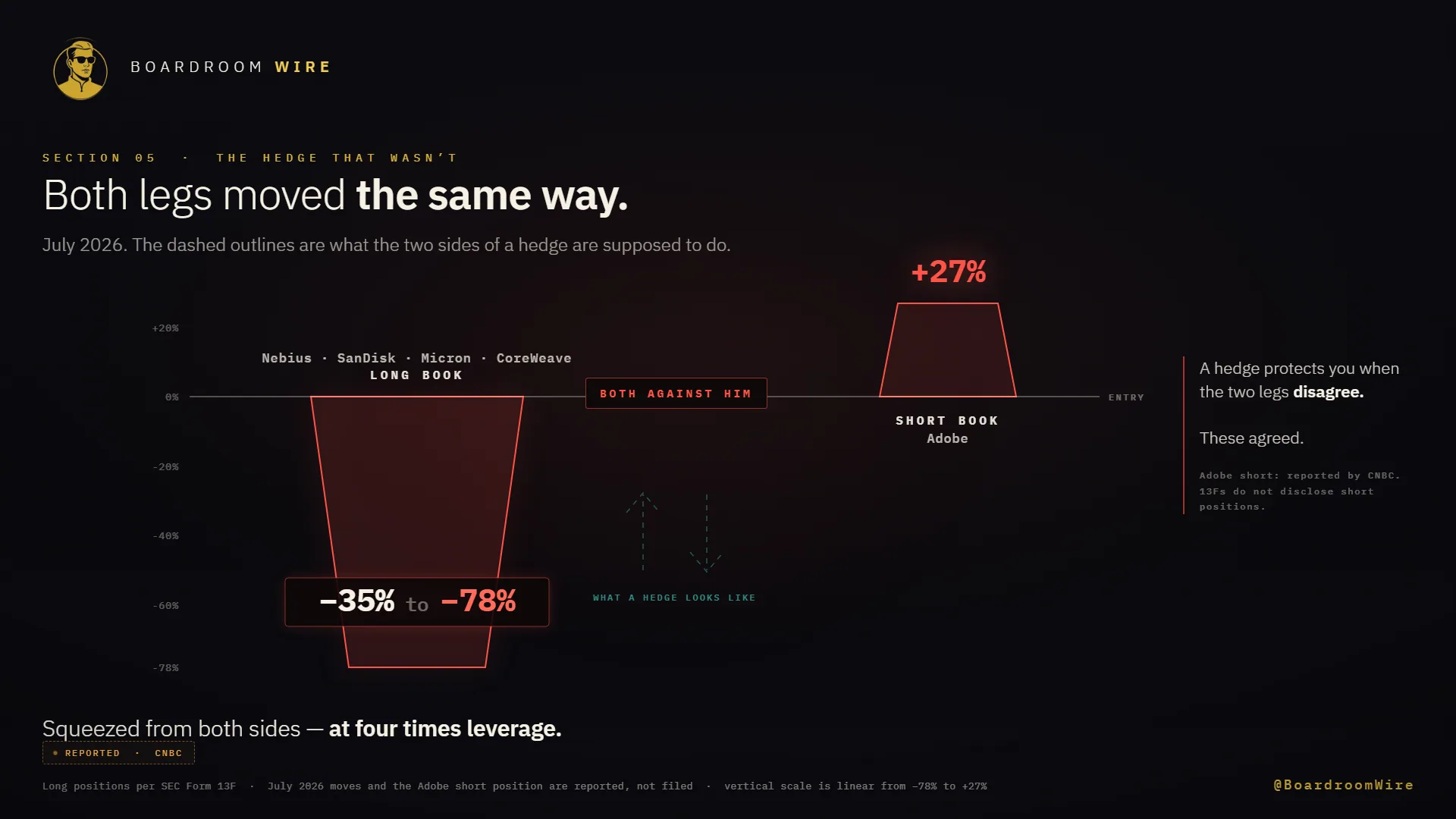
And this was compounded by the fact that Leopold also had short positions in legacy software names that ripped during this same period. Stocks like Adobe, which Leopold reportedly had on as a short, rose 27% in July.
 Tap to enlarge
 SourceLong positions per SEC Form 13F. July 2026 moves and the Adobe short are reported (CNBC), not filed; 13Fs do not disclose shorts.
So Leopold effectively got squeezed on both sides at once, while being levered to the gills.
This created a compounding effect, where the fund had to sell its AI names, pushing those prices lower, and buy to close its shorts, pushing those names up further.
By the end of it, the fund was down 67% for the month. Roughly $35 billion, gone in about four weeks.
Trying to survive
To Leopold’s credit, he didn’t go quietly.
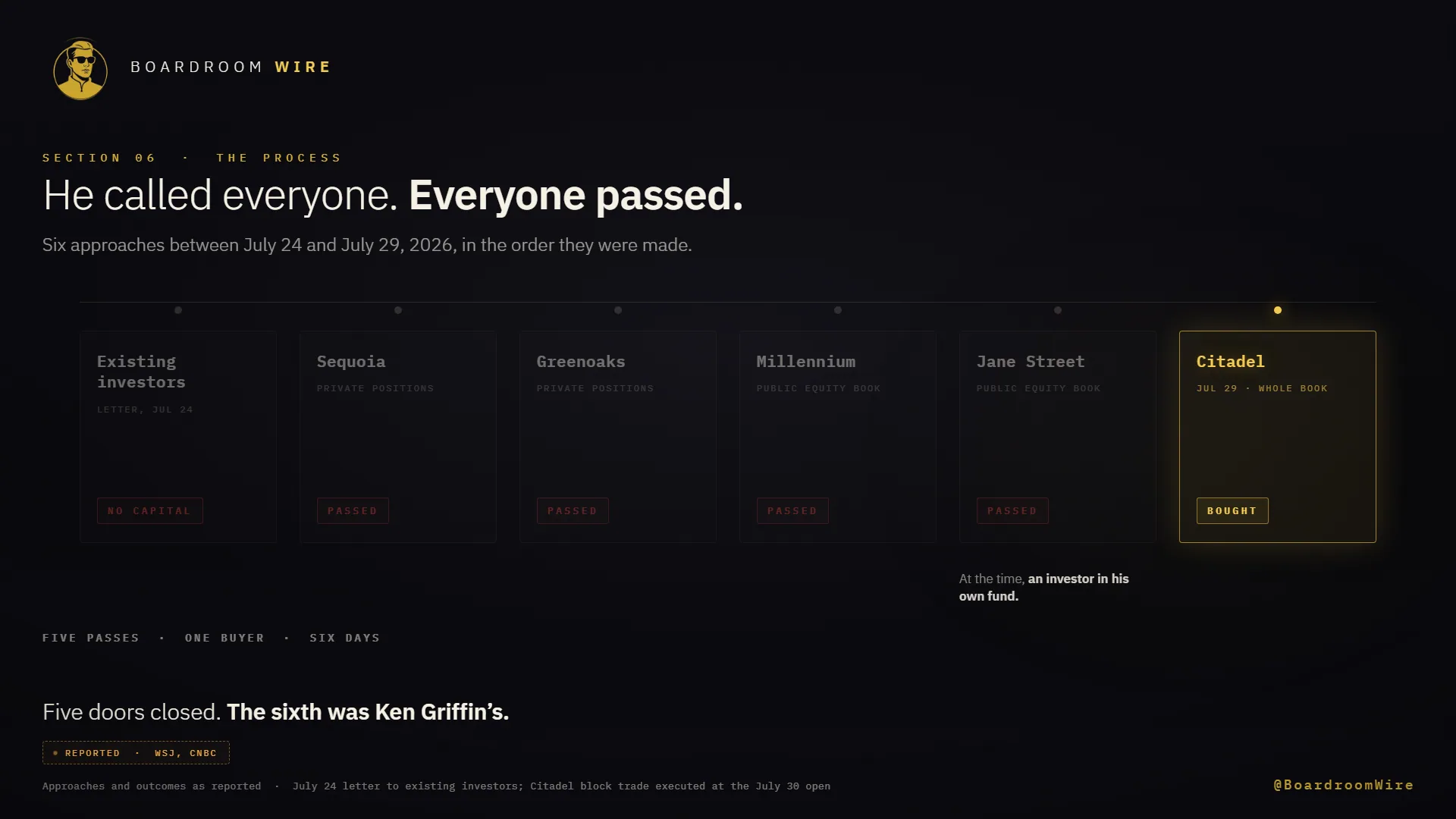
He first went back to his own investors, writing to them on July 24th and asking them to commit fresh capital by August 1st. That was unsuccessful. The money never came.
From there, he ran a process.
 Tap to enlarge
 SourceApproaches and outcomes as reported (WSJ, CNBC). July 24 letter to investors; Citadel block trade at the July 30 open.
He approached Sequoia and Greenoaks about buying private positions off the book, including part of his Anthropic stake. That fell through. He offered existing investors the chance to buy assets directly out of the portfolio. He shopped the public equity book to Millennium. He shopped it to Jane Street, a firm that was, at the time, an investor in his own fund.
Everyone passed.
And then on July 29th, with the margin calls escalating and the clock running out, the process reached Ken Griffin’s Citadel.
Citadel
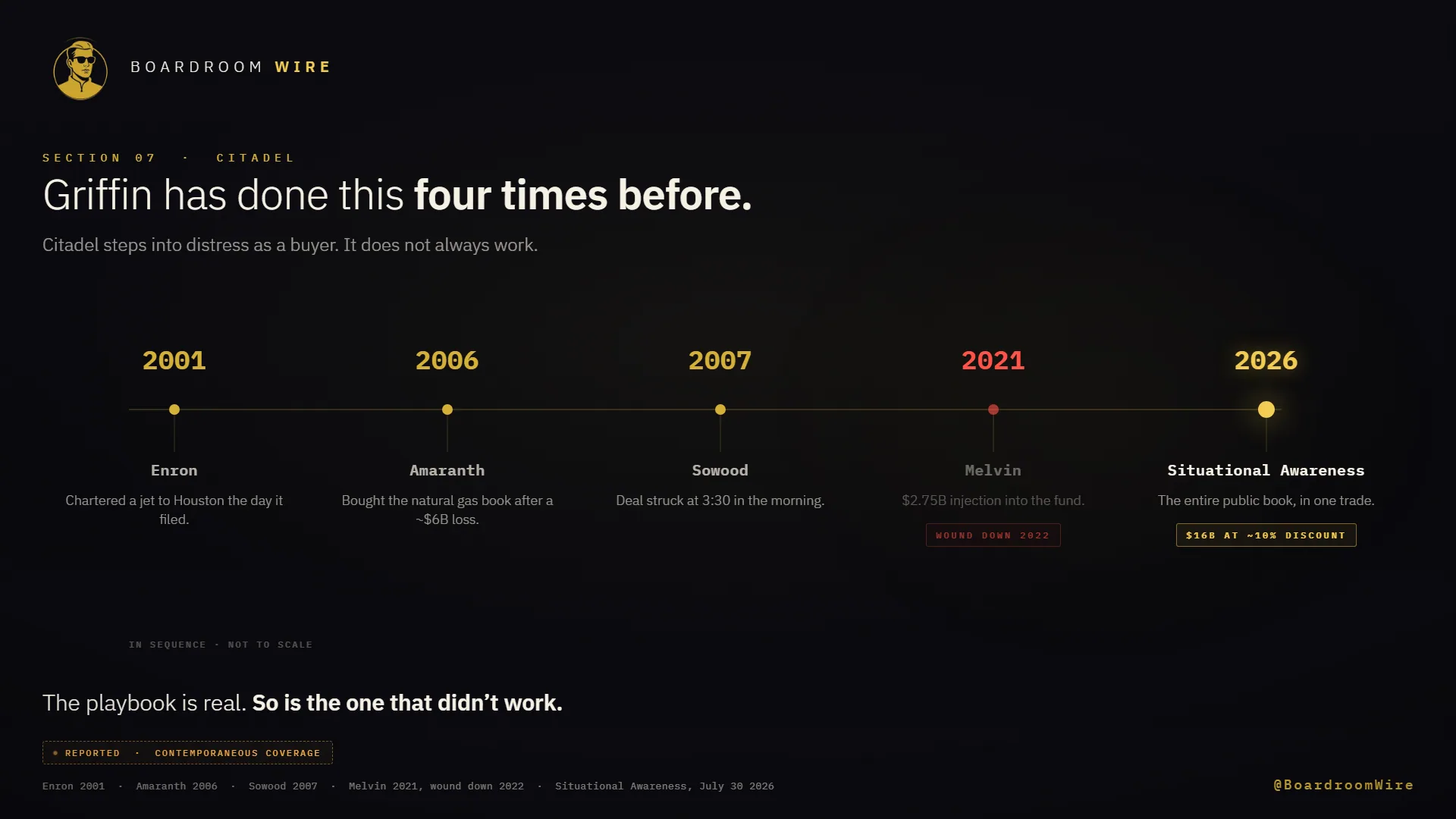
Ken Griffin started trading out of his Harvard dorm room in the late 1980s. He founded Citadel in 1990 with about $4.6 million. Today the firm has generated something on the order of $90 billion in net gains over 35 years.
And Griffin has a lot of experience in rescue financing. Citadel has regularly stepped in to provide companies and funds with capital during distressed periods.
 Tap to enlarge
 SourceEnron 2001 · Amaranth 2006 · Sowood 2007 · Melvin 2021, wound down 2022 · Situational Awareness, July 30 2026.
On July 29th, Citadel got the call from Situational Awareness. By the open on July 30th, the deal was done.
Citadel bought Situational Awareness’s entire public equity book in a single trade for roughly $16 billion, securing the assets at almost 10% below market value, and enabling Leopold and Situational Awareness to fight another day.
The day after
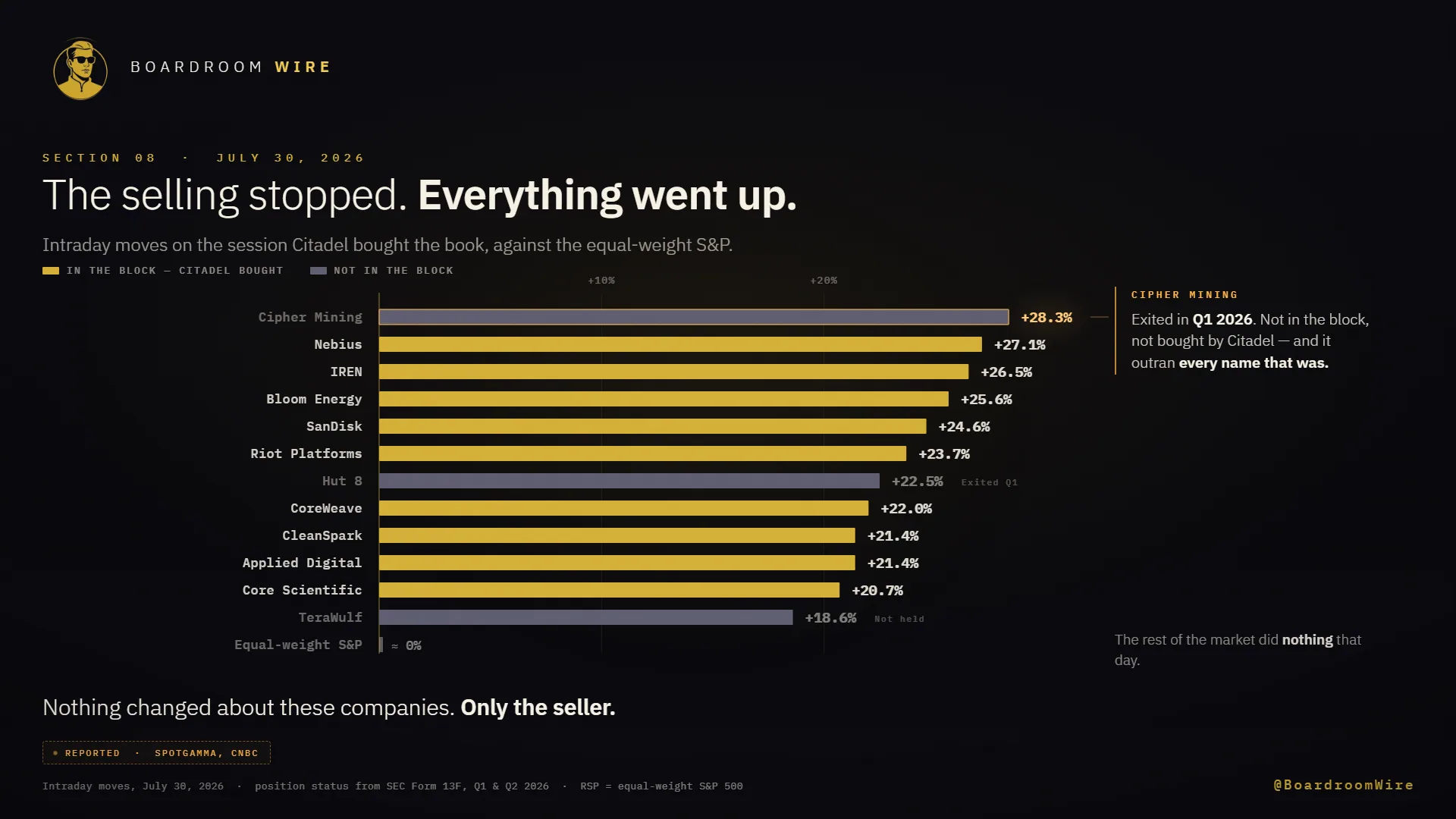
The moment Citadel took that book off Leopold’s hands, the selling stopped. And by three o’clock on July 30th, the same session, every single position in that portfolio was up 20 to 27 percent.
 Tap to enlarge
 SourceIntraday moves, July 30, 2026 (SpotGamma, CNBC). Position status from SEC Form 13F, Q1 & Q2 2026.
Nebius up 27.1%. IREN up 26.5%. Bloom Energy up 25.6%. SanDisk up 24.6%. CoreWeave up 22%.
Citadel made a killing off the trade. And on August 21st, Griffin announced they had already unwound over 80% of the book. Griffin and Citadel were able to parlay Situational Awareness’s poor risk management into a mammoth return in under a month.
For Leopold and Situational Awareness, it has to sting. But it was made even worse by the fact that all of this happened just days before his wedding, on August 1st in Carmel, California. On what was undoubtedly one of the highest personal moments in his life, he had to grapple with the biggest professional low he’d faced to that point. He allegedly cancelled his honeymoon to return to the fund.
On the brighter side for Leopold, Situational Awareness survived to fight another day. He was able to maintain a material amount of capital, as well as the fund’s private stake in Anthropic.
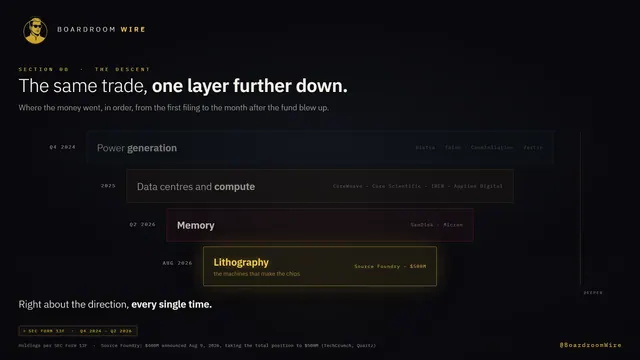
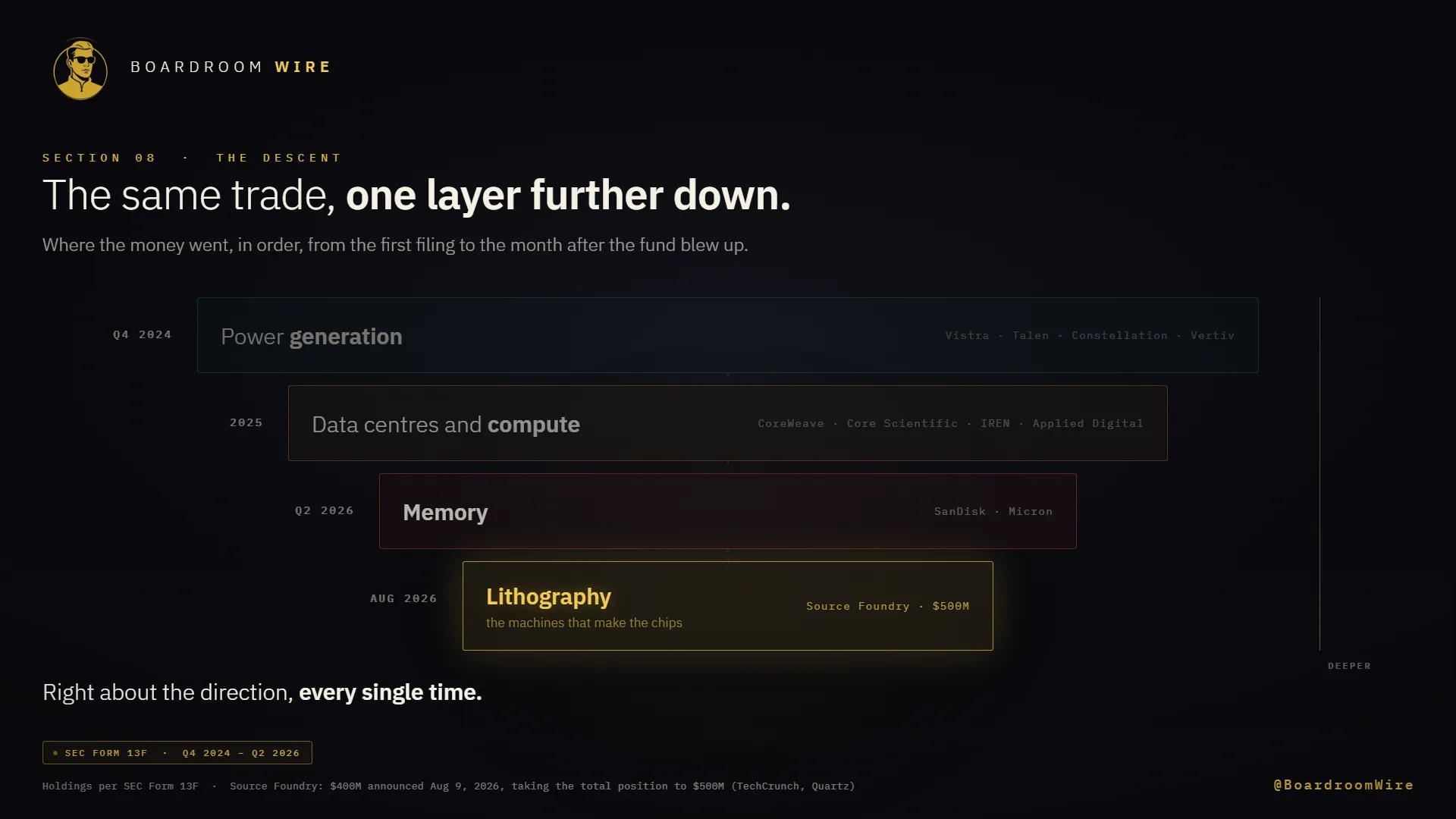
And just days after the Citadel trade, they put $400 million into a startup called Source Foundry, a Stanford-founded company building the machines that manufacture AI chips, taking direct aim at ASML. That brought their total position to $500 million, and signalled they don’t intend on exiting the investing arena anytime soon.
Which, if you think about it, is the same trade he’s been making since day one. Power. Then data centers. Then memory. Now the machines that make the chips. Each time, one layer further down.
 Tap to enlarge
 SourceHoldings per SEC Form 13F. Source Foundry: $400M announced Aug 9, 2026, taking the total position to $500M (TechCrunch, Quartz).
Ultimately, Leopold Aschenbrenner was right about artificial intelligence, right about the power bottleneck, right about memory, and right about the capital expenditure supercycle. He was so right that the biggest companies on earth are spending seven hundred billion dollars this year proving it.
And none of that mattered.
Because being right about where the world is going doesn’t help you if you can’t stay solvent long enough to be there when it arrives.
Charts in this article
14 dashboards, each with its own page.
Open the full set, with sources and method →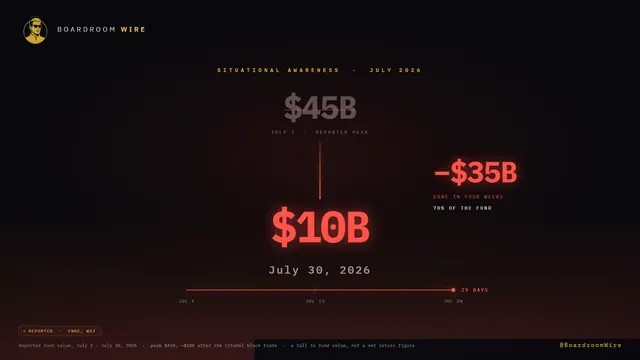
$45B to $10B
Cold open Reported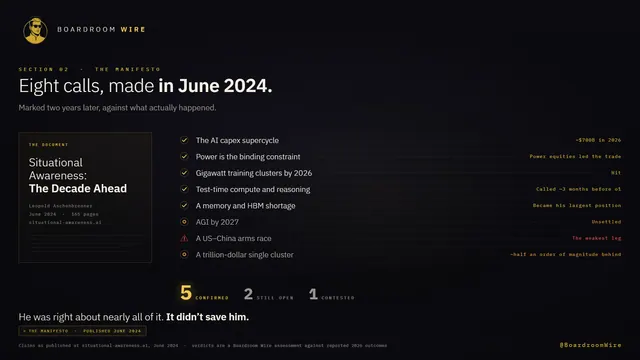
The Manifesto Scorecard
The manifesto SEC primary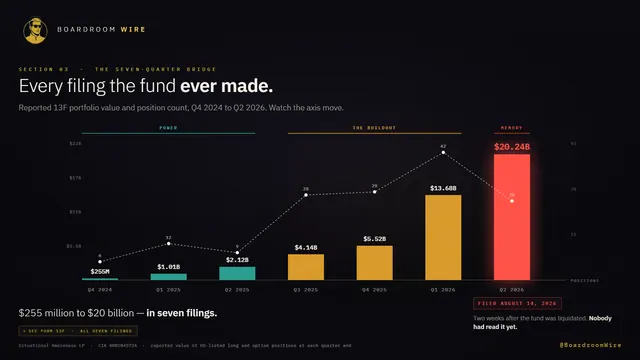
The Seven-Quarter Bridge
The rise SEC primary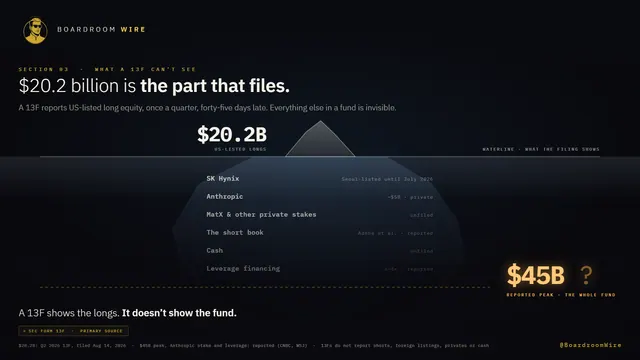
What a 13F Can't See
The rise SEC primary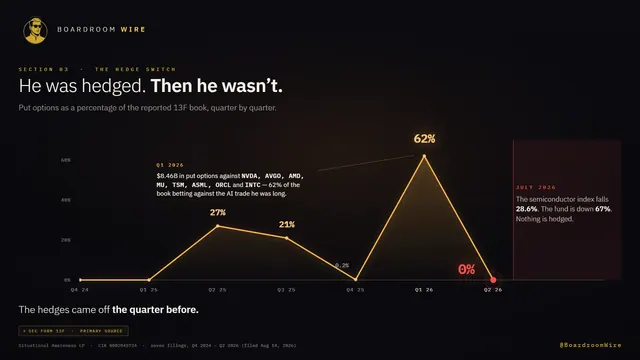
The Hedge Switch
The rise SEC primary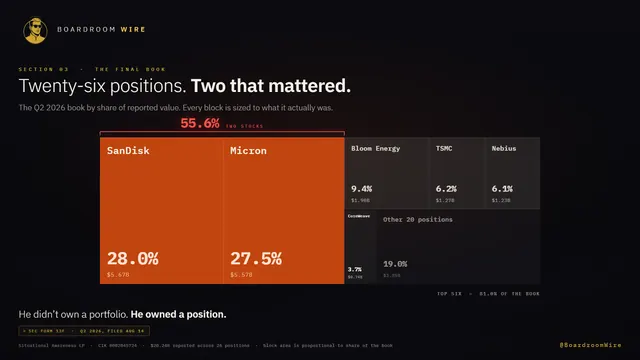
The Final Book
The rise SEC primary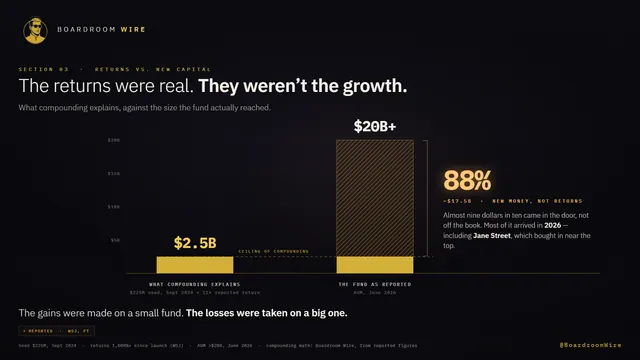
Returns vs. New Capital
The rise Reported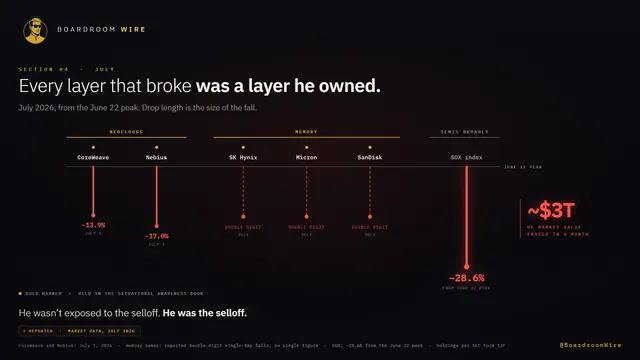
The Layers Break
July Reported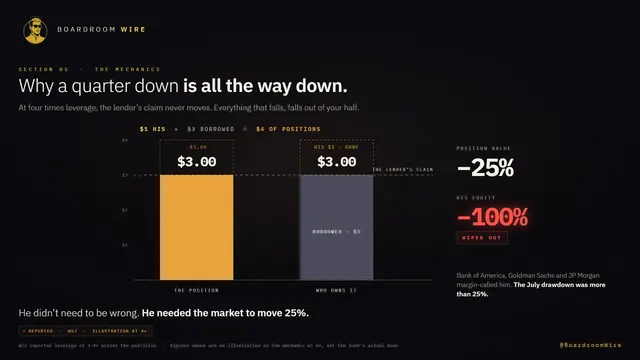
The Leverage Multiplier
The mechanics Reported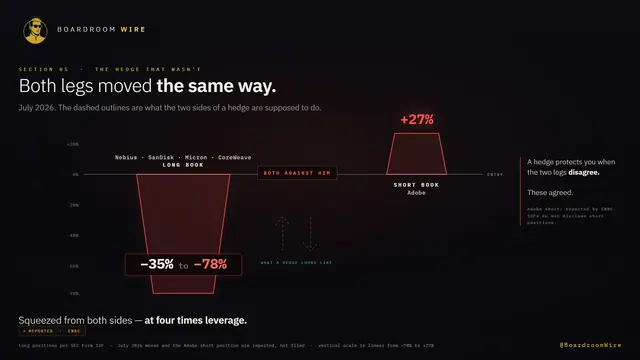
The Hedge That Wasn't
The mechanics Reported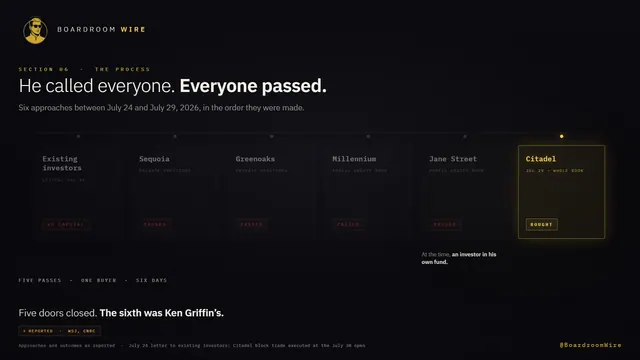
Doors Closing
Trying to survive Reported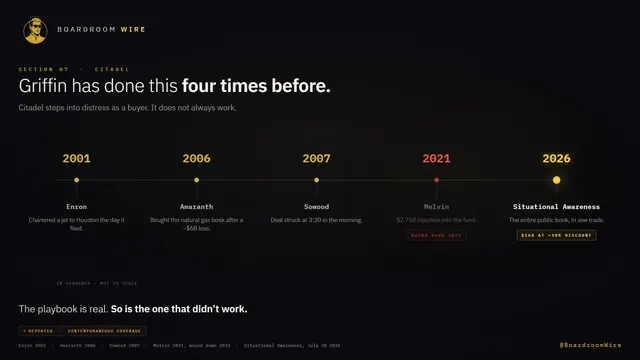
Citadel's Crisis Playbook
Citadel Reported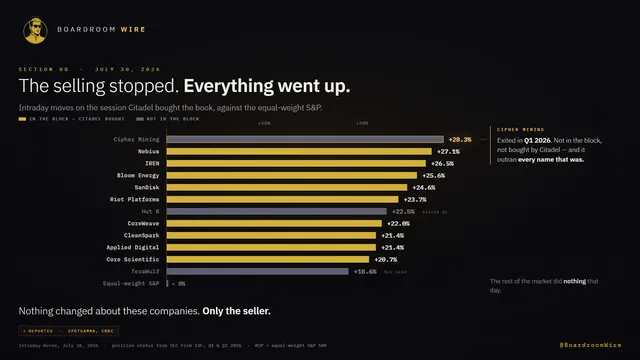
July 30: The Rebound Tell
The day after Reported