Fourteen dashboards
Situational Awareness: the $45B blowup.
Leopold Aschenbrenner raised $225 million, compounded it past $20 billion, and lost most of it in twenty-nine days. Every filing the fund ever made, charted, plus the mechanics of how a 25% drawdown became a 100% loss.
Read the article Situational Awareness: The $45 Billion Blowup →How to read these
Every dashboard carries a source chip in its lower-left corner, and the distinction is deliberate.
- SEC primary Taken straight from the fund’s Form 13F filings (CIK 0002045724). Six of the fourteen dashboards are built entirely on filed documents.
- Reported Sourced to journalism (CNBC, the Wall Street Journal, the Financial Times) or, in two cases, to our own arithmetic on reported figures. Attribution is printed on the dashboard itself, not just here.
A 13F discloses US-listed long positions only. It does not show short positions, foreign listings, private holdings or cash, which is why the filings total $20.2 billion against a fund reported at $45 billion. Dashboard 04 exists to reconcile exactly that.
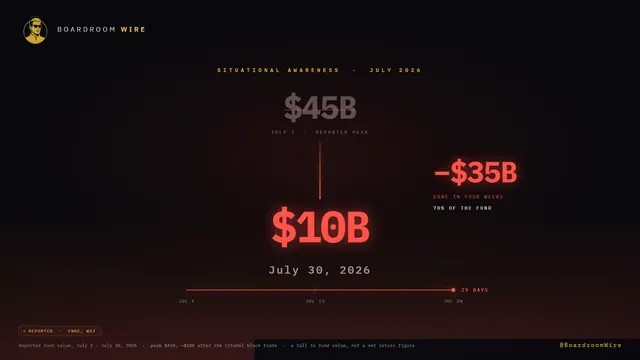
$45B to $10B
The month runs on one clock: the number falls down the frame, shrinking as it goes, and leaves its starting point struck through behind it.
Cold open Reported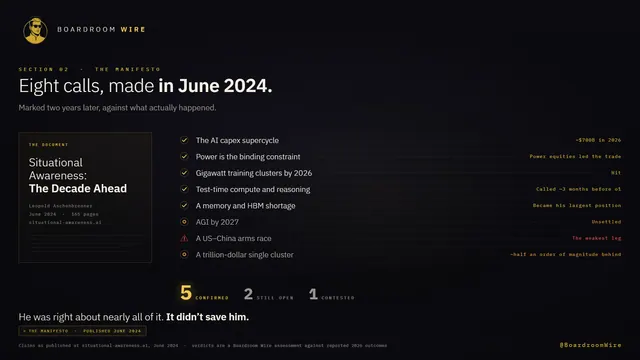
The Manifesto Scorecard
Eight predictions from the June 2024 manifesto, marked two years later against what actually happened. Five confirmed, two still open, one contested.
The manifesto SEC primary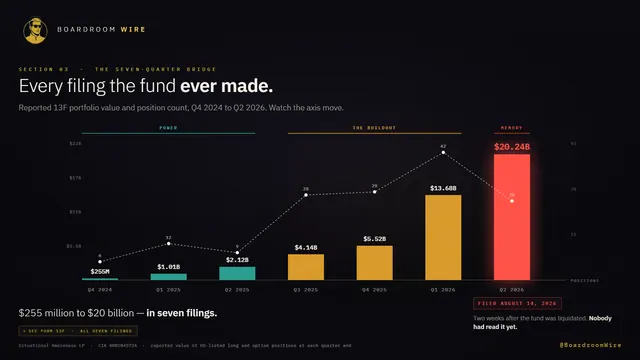
The Seven-Quarter Bridge
Every 13F the fund ever filed, in order. The y-axis retreats as each quarter overruns it. The axis moving is the growth.
The rise SEC primary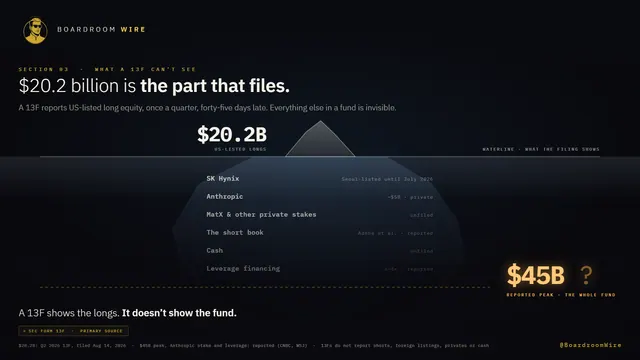
What a 13F Can't See
$20.2 billion is the part that files. The camera dives past the waterline and the rest of the fund surfaces: SK Hynix, Anthropic, the short book, the leverage.
The rise SEC primary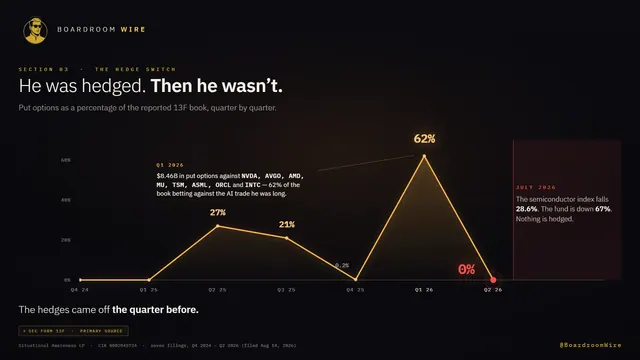
The Hedge Switch
Put options as a share of the book, quarter by quarter: zero, to 62%, to zero, the quarter before the fund blew up.
The rise SEC primary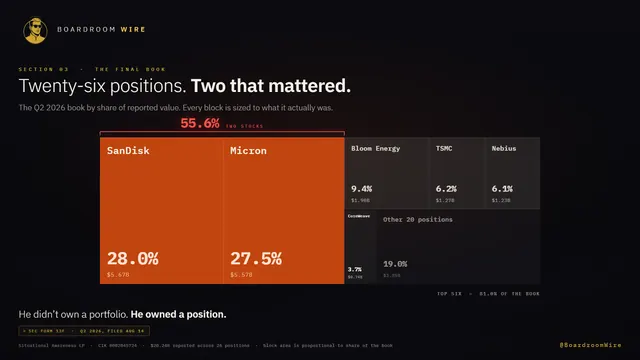
The Final Book
Twenty-six positions, sized by share of value. SanDisk and Micron are 55.6% of the book between them. Every block is drawn to scale.
The rise SEC primary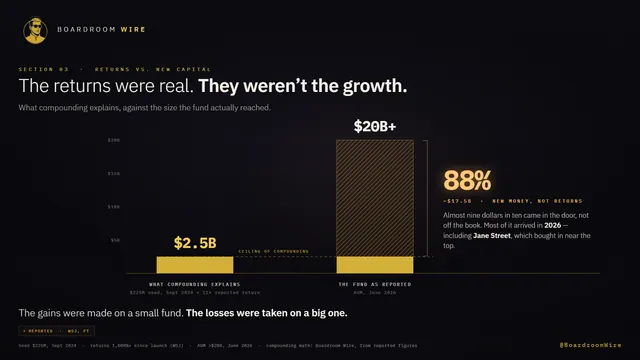
Returns vs. New Capital
What compounding actually explains, against the size the fund reached. Roughly 88% of the growth was new money, not returns.
The rise Reported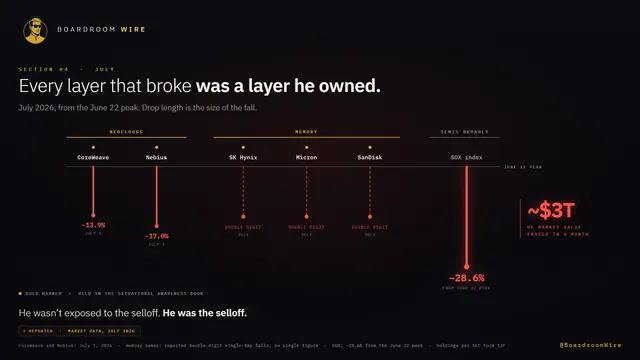
The Layers Break
July 2026, from the June 22 peak. Every layer that broke was a layer he owned, and unquantified falls are drawn as unquantified.
July Reported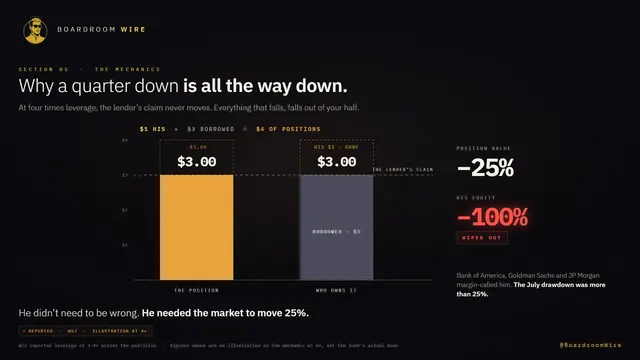
The Leverage Multiplier
Why a quarter down is all the way down. The lender’s claim never moves, so everything that falls comes out of your half.
The mechanics Reported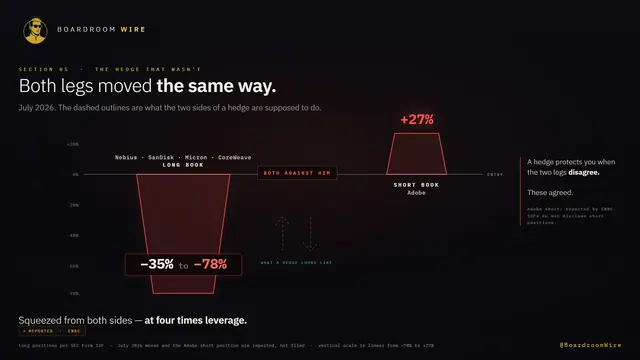
The Hedge That Wasn't
A hedge protects you when the two legs disagree. In July 2026 the long book fell as much as 78% and the short leg rose 27%.
The mechanics Reported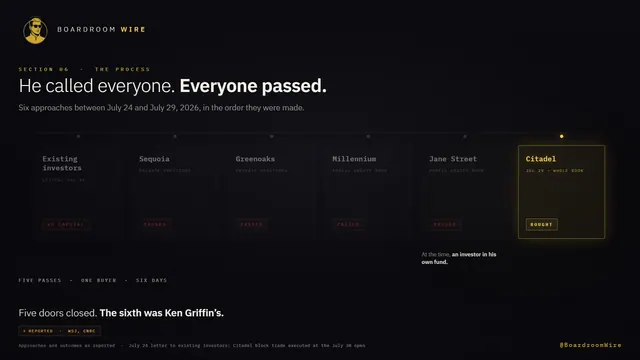
Doors Closing
Six approaches in six days. Five lamps go out, including Jane Street, an investor in his own fund, and then Citadel lights gold.
Trying to survive Reported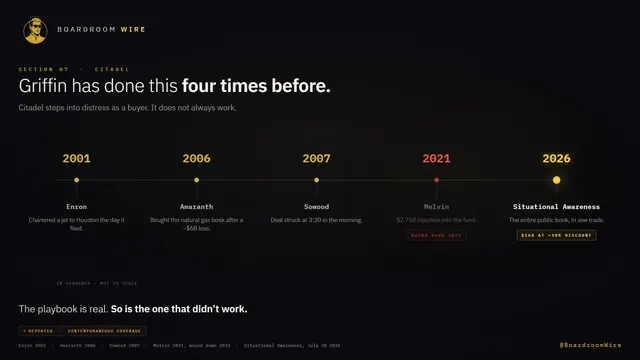
Citadel's Crisis Playbook
Five rescues across twenty-five years, including Melvin, which Citadel backed in 2021 and which wound down the year after.
Citadel Reported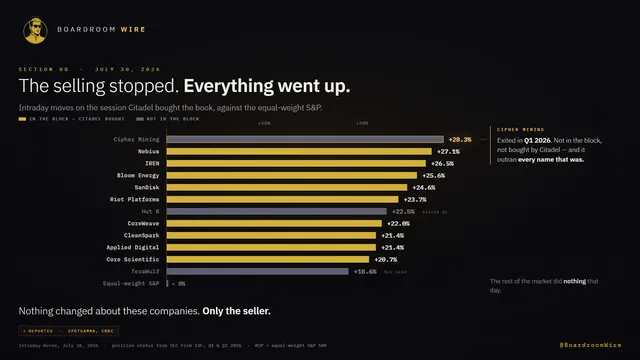
July 30: The Rebound Tell
The session Citadel bought the book, everything rallied. Cipher Mining (already sold, not in the block) outran every name that was.
The day after Reported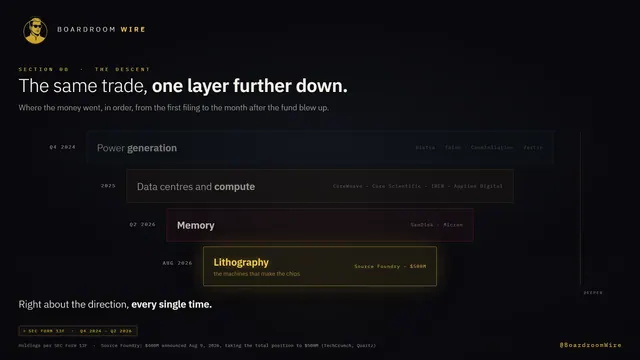
The Descent Through the Stack
Power, then data centres, then memory, then the machines that make the chips. Each layer narrower, deeper and dimmer than the one above.
The day after SEC primary